Why Your AI-Content System Breaks Every Time You Improve It
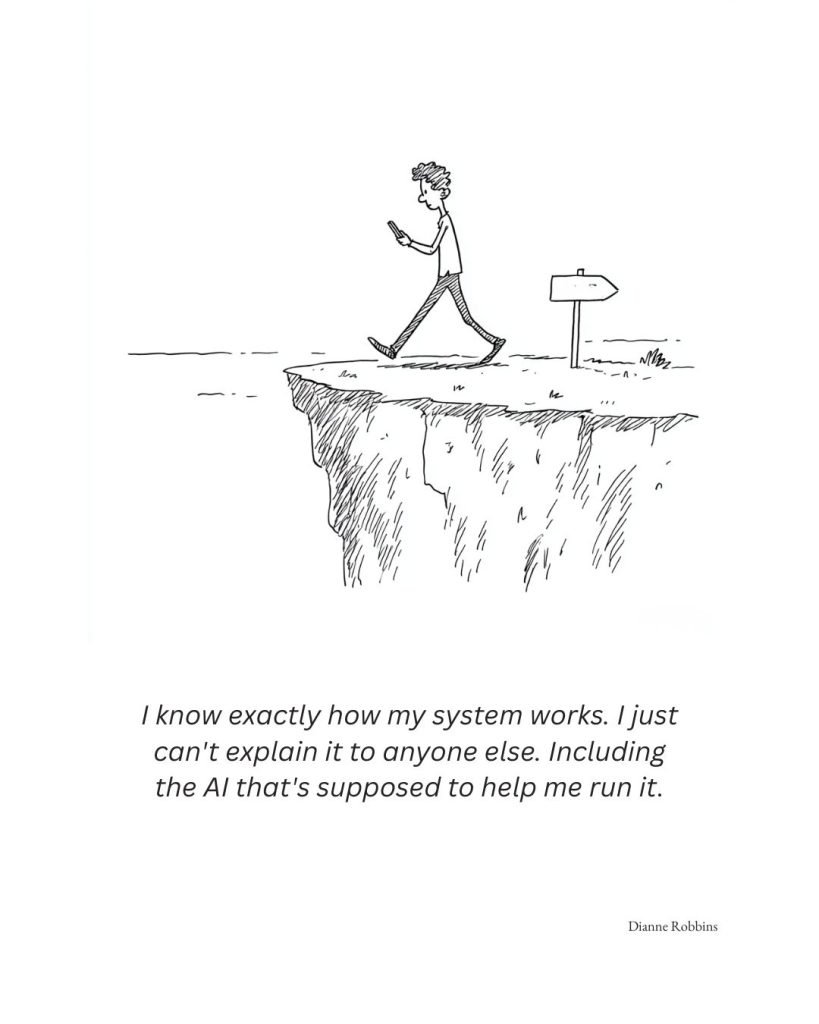
The stability of your content system depends on whether your decisions exist in documents or only in your head. What lives only in your head feels efficient until something changes—a new platform, a shifted focus, a collaborator, an AI tool. Then you discover you weren’t running a system. You were running on memory, and memory doesn’t transfer.
You improve your workflow. You add a new platform. You bring in help—human or AI. You integrate a new tool that promises to streamline what you’ve been doing manually. Each change should make things easier. Instead, each change breaks something that was working previously. You spend hours explaining what you want, re-establishing standards that felt obvious, rebuilding processes you thought were solid.
The issue isn’t the change. It’s that your “system” existed only in your head.
The fix isn’t complicated—it starts with documenting one format, capturing the decisions you’re already making. But understanding why that works requires seeing what’s actually breaking.
The Pattern: Systems That Break When They Should Scale
You’ve built something that works. Your content has a voice. Your workflow has a rhythm. Your quality is consistent enough that
You’ve built something that works. Your content has a voice. Your workflow has a rhythm. Your quality is consistent enough that you trust the output. Then you try to grow it—add a platform, delegate a task, integrate a tool—and the whole thing wobbles.
You try to hand off a task—and explaining it takes longer than doing it yourself.
You try to onboard an AI tool. You write a prompt. The output is fine. Generic. Not what you wanted. So you revise the prompt. Add more context. Try again. Still not right. You’d have to re-decide everything from scratch to write instructions that capture what you actually want.
You want AI to adapt what’s working on LinkedIn for YouTube. But you can’t tell AI what made the LinkedIn approach work—because you never articulated it. You just know it does, not why.
This isn’t a failure of the change you’re trying to make. It’s a revelation about what you actually built. You built something that works for you, right now, under current conditions. You didn’t build something that works independently of your memory—which means you didn’t build something AI can use.
AI doesn’t create this problem. It makes it visible sooner—and amplifies it faster.
Why Memory Degrades and Documents Compound
Memory doesn’t store decisions—it reconstructs them. Each time you recall how you approach a content piece, you’re not retrieving a file from storage. You’re rebuilding the decision from fragments in your memory, filling gaps with current context, adjusting based on what feels right now. Over months, your “system” shifts without any conscious change on your part.
This is why your voice starts to drift. Not because you decided to change it, but because the version of your voice you’re reconstructing today isn’t identical to the version you reconstructed six months ago. The drift is invisible because you’re evaluating output against a memory that’s reconstructing at the same time.
Documents work differently. They don’t reconstruct—they persist. A documented decision remains exactly what it was when you wrote it down, which means you can compare current output against the original intention and see the gap. Each decision you document becomes a foundation for the next. You see patterns. AI has something to build on. Gaps become obvious. Improvements compound on stable ground rather than drifting.
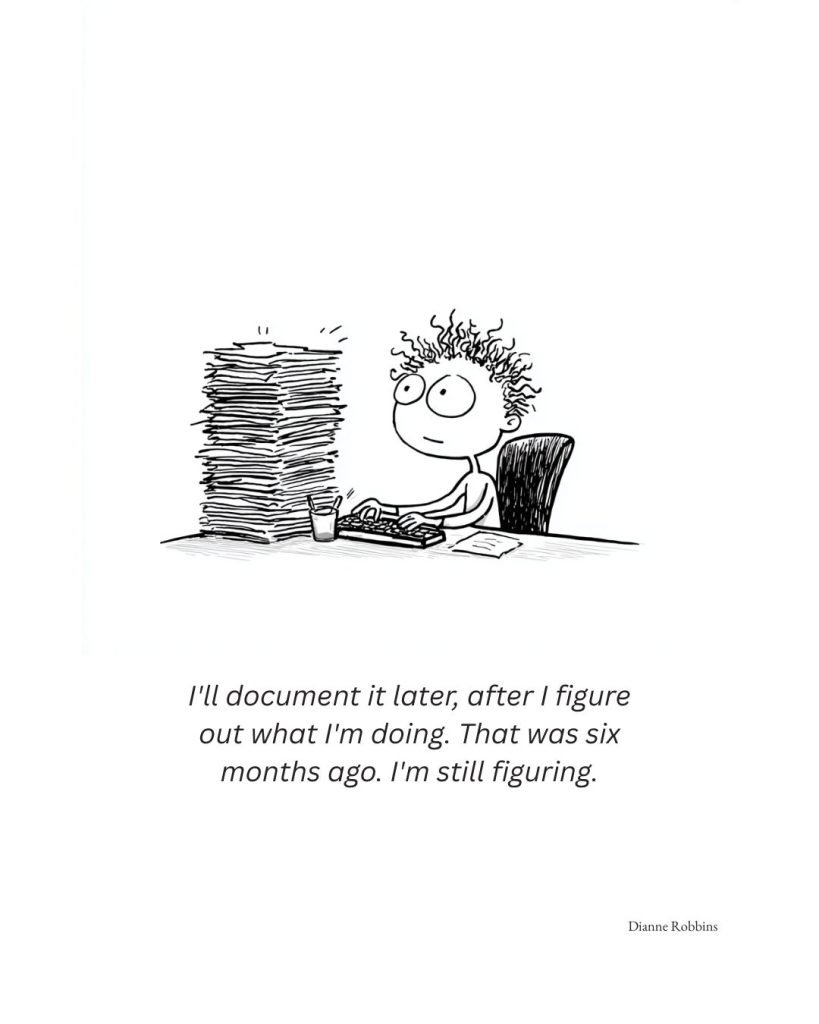
When I started building documentation for my AI-assisted workflow, I didn’t do it because I planned to delegate. I did it because I couldn’t maintain consistency without giving AI something concrete to work from.
I discovered I was making the same corrections to AI output over and over—the same voice fixes, the same structural adjustments—because the decisions existed nowhere the AI could use them.
Once the decisions were documented, AI could use them from the start—and I stopped spending my time fixing what should have been right the first time.
Related Post: Build a Smarter AI Content Workflow
What Documentation Actually Does
Documentation surfaces the less obvious decisions. When you write down how you approach something, you discover the choices you didn’t realize you were making. Your voice has patterns you’ve never articulated. Your workflow has decision points you navigate automatically. Your quality standards exist as feelings rather than spelled-out criteria.
The act of documenting forces these decisions into the explicit. You can’t write “make it sound like me” in a document meant to guide AI output—you have to specify what “sounding like you” actually means. You can’t write “make sure it’s good” as a quality checkpoint—you have to define what good looks like in terms AI could evaluate.
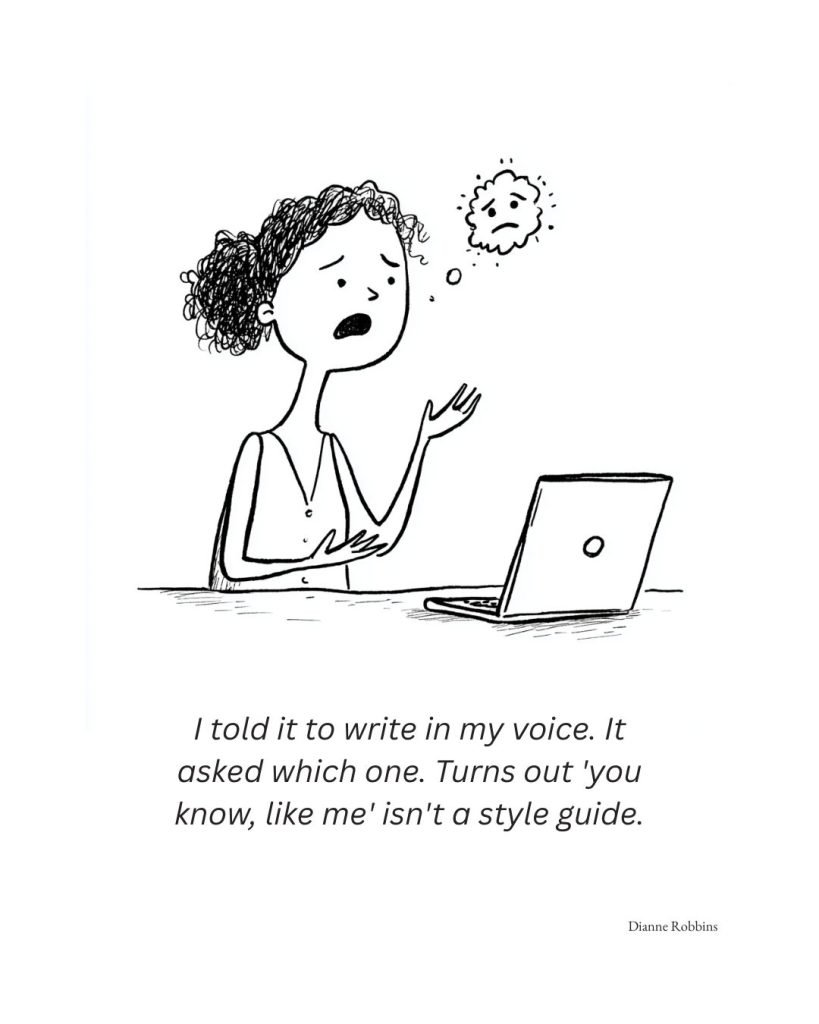
Before I documented my voice standards, my internal instruction was “make it sound like me—direct, clear, human, no fluff.” That instruction was useless to anyone but me, including AI tools. After documentation, the same standard became specific: sentences average 15-20 words, no more than two clauses per sentence, second person throughout, no hedging phrases like “might” or “perhaps,” every claim includes the reasoning behind it. The first version required my personal judgment to interpret. The second version could be checked by anyone—or any tool—against actual output.
Documentation enables delegation—to AI tools, to collaborators, to your future self who won’t remember why you decided something. The difference between “make it match my voice” and a document that specifies what your voice actually sounds like is the difference between an instruction no one can follow and a standard anyone could check against.
Why AI Makes This Unavoidable
Everything I’ve described about documentation becomes unavoidable when AI is part of your workflow. AI tools can’t read your mind. They can’t access your memory of how things are supposed to work. They can only work with what you give them—and if what you give them is vague instruction based on standards you haven’t articulated, you’ll get output that drifts in ways you can’t diagnose.
The prompt “write this in my voice” is meaningless to an AI that has no reference for what your voice actually is. You’ll get something generic, or something that pattern-matches to voices in its training data, or something that feels close enough until you realize three months later that your content sounds increasingly like everyone else’s content. The drift is invisible because you’re evaluating each piece against your memory of your voice—and your memory is reconstructing too.
Documented voice standards change the equation entirely. When you can hand an AI tool a document that specifies sentence length patterns, specific phrases you use and avoid, structural preferences, tone markers for different content types—now you’re giving it something it can actually use.
And you’re giving yourself something to check against. When output drifts, you can identify exactly where it diverged and fix the documentation once—instead of making the same correction every time.
Quality standards that exist only in your head can’t guide an AI tool and can’t help you evaluate AI output. Structure preferences you’ve never articulated become invisible to any system that isn’t you. The decisions you’ve been making unconsciously—about what makes content good, about where review should happen, about what tradeoffs you’re willing to accept—those decisions need to be explicit before AI can serve them rather than override them.
This is why documentation isn’t optional overhead for AI-integrated content systems. It’s the infrastructure that makes AI integration sustainable. Without it, you’re not using AI as a tool that serves you—you’re hoping each output happens to match standards you haven’t clearly defined. That’s not a system. That’s luck, and luck doesn’t scale.
The Tradeoff: What Documentation Actually Costs
Documentation takes time you could spend creating. Building a comprehensive document for even one content format—voice standards, structure requirements, quality checks, platform adaptations—can take several hours. Hours that produce no publishable content, no direct audience value, no immediate return. The opportunity cost is concrete and immediate.
Documentation introduces friction around change. When an approach is written down, changing it requires revisiting what’s been documented. This often helps prevent drift, but it can also slow real progress. You may keep a documented approach longer than necessary because updating the documentation feels like additional effort.
Documentation requires maintenance. Documents that don’t get updated become misleading—worse than no documents at all.
The time cost is front-loaded, which makes it feel heavier than it is. You invest hours now for benefits that accrue over months. If you’re in crisis mode, shipping content to survive, documentation feels like a luxury you can’t afford. The irony is that the crisis often exists because you didn’t document earlier—but that doesn’t make the current time pressure any less real.
Despite these costs, the tradeoff favors documentation. The time investment is bounded. The friction prevents drift. The maintenance burden is lighter than re-making decisions you’ve already made.
What This Looks Like in Practice
I built documentation for every content format I create—not as a style guide to consult, but as operational infrastructure that AI uses to draft content aligned with my standards from the start.
In my own workflow, research becomes an input AI can actually use. Once approved, AI drafts the post according to my documented standards—voice, structure, quality checks—so the output is already aligned before I see it. My review focuses on whether the piece says what I actually intend to say, not on fixing problems the documentation should have prevented.
When I create a visual asset, AI writes the prompt based on documented style specifications. The output matches my visual language because the documentation shaped what was requested.
When I adapt content for a new platform, AI follows documented guidelines for what changes and what stays the same.
When I change something in my approach, I update the documentation first—before changing behavior. If I can’t articulate why I’m changing the documentation, I probably haven’t thought clearly enough about why I’m changing the approach.
I’m not sharing the actual documents here. They’re operational infrastructure, not teaching materials—giving you my answers to questions you haven’t asked yet would shortcut the process that makes documentation valuable. What would help you isn’t my documents but the process of building documentation that makes AI a genuine partner in your work.
Related: How to Make AI Preserve Your Voice Consistently
Where to Start
Start with one format—whatever you produce most frequently. Document the decisions you’re currently making unconsciously: How do you know when a piece is ready? What makes something sound like you? Write it down as an honest description of what you actually do, not aspirational standards.
AI can help. Ask it to evaluate your published content and propose guidelines based on patterns it identifies. You’ll still decide which patterns are intentional, but the initial extraction is faster than building from scratch.
Expand gradually. Once you’ve documented one format, repeat the process for the next. The system compounds—each documented format makes the next easier, because you start seeing patterns across formats that you can articulate once and reference everywhere.
The Diagnostic Check
You can assess where you are right now by answering a few questions honestly.
If you had to hand off your content workflow tomorrow—to an AI tool, a collaborator, your future self—how much would live in documents versus in your head? The gap reveals how much of your system exists only in your memory.
When you “improve” your process, do you update documentation—or just change behavior? If you’re only changing behavior, you’re accumulating invisible drift that compounds until something breaks.
Can you point to where your voice standards are written, or do you just “know” them? If you just know them, you’re one memory reconstruction away from drift you won’t detect.
Could AI evaluate your content against documented standards, or would it need you to react to drafts and say “not that”? If evaluation requires your personal judgment every time, you haven’t built a system—you’ve built a dependency on your continued attention.
The signals that you’re running on memory are consistent. You keep making the same corrections to AI output. You can’t explain your standards in writing—only by reacting to drafts. Changes that should improve your workflow create new problems because AI has no reference point for what you actually want.
The signals that you’re running on documentation are equally consistent. AI produces aligned output before you review it. Your corrections are about substance, not voice or structure. When something drifts, you can identify exactly where and fix the documentation once instead of fixing every output.
The Foundation That Doesn’t Show
Your AI-assisted content system is only as stable as your documentation.
Memory creates the illusion of efficiency by hiding the true cost of correction—the time spent fixing the same AI output issues over and over, the drift you can’t detect because you have no reference point, the frustration that builds every time you think “why can’t AI just get this right?”
AI can get it right. But only if you give it something concrete to work from.
Documentation creates actual efficiency by making your decisions usable—by AI, from the start. You stop correcting and start collaborating. You stop re-deciding and start building.
It’s not glamorous work. It doesn’t produce content anyone will see. It won’t generate engagement or build your audience directly.
But it’s what separates AI-assisted workflows that scale from ones that break every time you try to scale them.
The infrastructure you can’t see is the infrastructure that holds everything else together.
Frequently Asked Questions (FAQ)
How detailed should documentation be?
Detailed enough that AI could evaluate output against it without asking you. If your documentation says “make it conversational,” that’s not detailed enough—AI can’t check whether something is conversational without your subjective judgment. If it says “sentences average 15-20 words, no more than two clauses per sentence, direct address throughout,” AI can actually verify compliance. The test: could AI use this document to produce aligned output and evaluate whether it succeeded? If it would still need you to react and say “not that,” the documentation isn’t detailed enough.
What if I don’t have time to document everything?
You don’t need to document everything at once. Start with whatever causes the most friction when AI produces output that misses the mark—for most people, that’s their core content format. Document that first, use it, refine it based on where AI still drifts, and only then expand to other formats. The time investment compounds, so starting small and building consistently beats waiting for a comprehensive documentation project that never happens.
How do I know if my documentation is working?
Three signals: First, AI produces usable output without extensive back-and-forth correction. Second, when something doesn’t work, you can identify specifically where it diverged from documented standards—instead of just knowing it “feels off.” Third, your quality is more consistent over time because variations are intentional rather than accidental. If you’re still making the same corrections to AI output repeatedly, still explaining things verbally that should be in documents, still getting drift you can’t diagnose—the documentation isn’t serving its purpose yet.
 Dianne Robbins, AI Systems Reasoning Strategist
People who create, lead, and publish face real questions when AI becomes part of their process: How do you maintain an authentic voice? Where’s the line between AI assistance and replacement? What happens to audience trust? This blog and my YouTube channel help you think through these questions—not to provide definitive answers, but to understand the complexity and make decisions that work for your situation. The focus is building decision-making confidence, not prescribing solutions.